🤖 The Blockbrain Brief #33

AI is moving from chat to autonomous work, while tighter cyber controls, infrastructure competition, and geopolitical pressure reshape enterprise deployment.
📩 High-level Summary
- Agents Adoption: OpenAI’s Codex adoption and Anthropic’s Claude Tag show AI taking on longer, shared tasks making permissions, agent identity, and oversight increasingly important.
- Tighter Controls on Cyber AI: OpenAI’s Daybreak expansion, limited GPT-5.5-Cyber access, and the reported GPT-5.6 restrictions suggest that advanced cyber-capable models may increasingly be released only to approved users.
- AI security and Data Rights: Anthropic’s alleged Alibaba-linked effort to extract Claude capabilities and the publisher lawsuit against OpenAI and Microsoft highlight growing concerns around model distillation, training data, and content ownership.
- Infrastructure & Sovereignty: Mistral’s open-model positioning, OpenAI’s Jalapeño chip, Amazon’s India expansion, chip-export tensions, and new low-energy inference approaches show that cost, energy use, hosting, and regional access now matter alongside model quality for competitive advantage
- Competitive Landscape: Claude is gaining consumer momentum while Google continues to lose prominent AI researchers, reinforcing the need for enterprises to regularly reassess model providers, capabilities, and user preferences.
GPT 5.5 Cyber is Now Available (to Trusted Defenders)
OpenAI is expanding Daybreak to help cybersecurity teams move from discovering software vulnerabilities to validating and patching them faster. The update includes a stronger Codex Security plugin, a partner program for trusted cybersecurity providers, and Patch the Planet, which connects researchers with maintainers of widely used open-source projects such as cURL, Go, Python, and Sigstore.
We’re expanding OpenAI Daybreak to help democratize patching vulnerable software at machine speed:
— OpenAI (@OpenAI) June 22, 2026
- Codex Security plugin: find, validate, and fix vulnerabilities right inside Codex
- The full version of GPT-5.5-Cyber model: a great model for trusted defenders
- Cyber Partner…
OpenAI also released the full version of GPT-5.5-Cyber to a limited group of trusted defenders, saying it outperformed GPT-5.5 on CyberGym. The controlled rollout reflects growing concern around cyber-capable AI models and suggests that the most advanced tools may increasingly be released only to verified users and organizations.
OpenAI uses AI in EVERY department
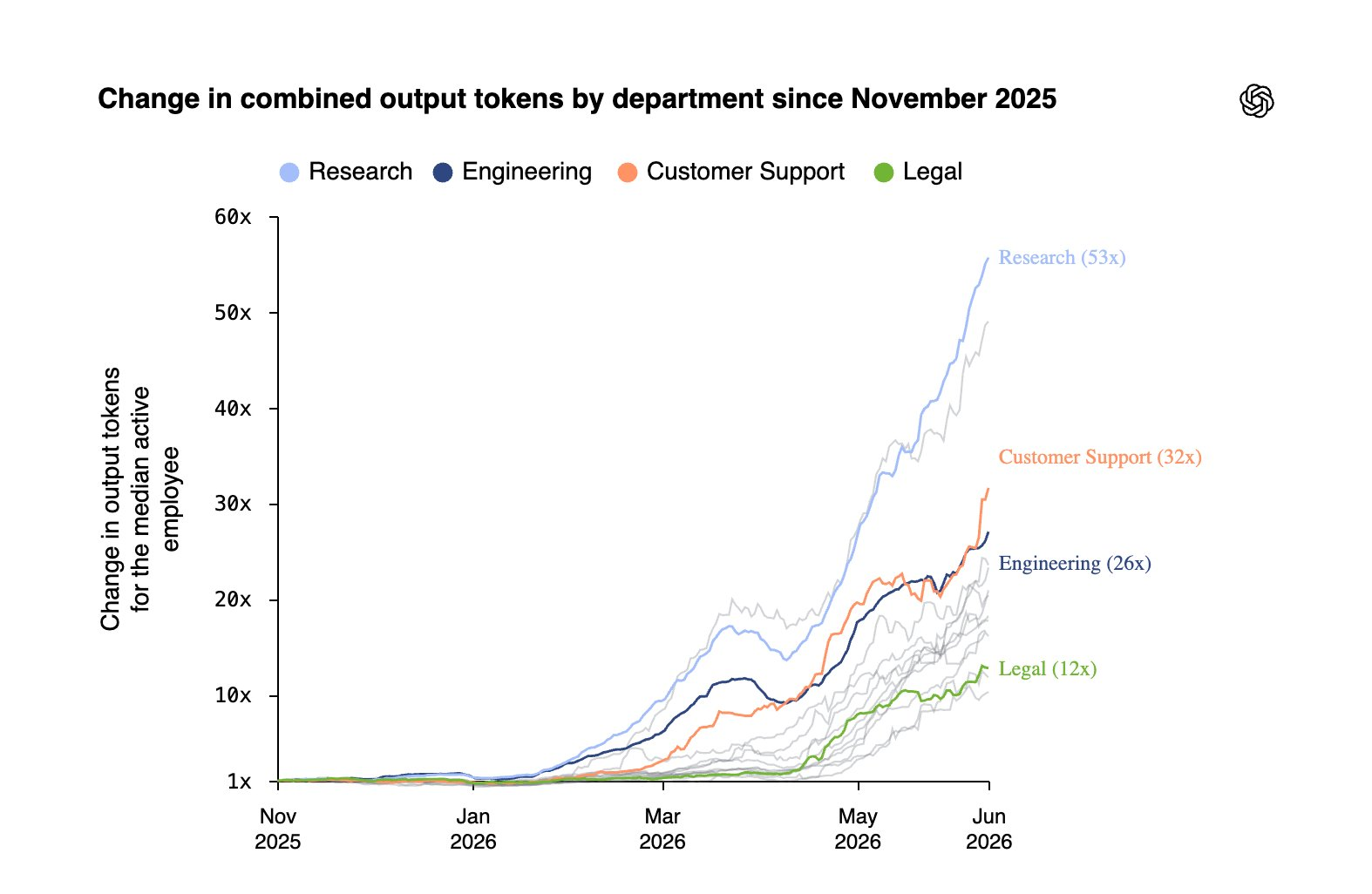
OpenAI says agents are shifting work away from short chatbot interactions and toward longer, delegated tasks. Internally, Codex has become a major AI tool across technical and non-technical teams, supporting coding, research, analysis, automation, and other tasks beyond employees’ usual job responsibilities.
Work at OpenAI is being transformed by agents, in every department.
— OpenAI (@OpenAI) June 25, 2026
Across our entire company, people are using Codex to do work that is more complex, longer-running, and increasingly cross-functional.
Our internal usage offers an early look at how agentic tools may reshape… pic.twitter.com/BwFTgBRfjZ
The company sees especially fast adoption among non-developers, who are increasingly using agents to perform more technical or cross-functional work. As agents improve, employees may be able to handle more complex tasks without relying as heavily on specialist teams.
Anthropic Redefines Multiplayer AI with Claude Tag in Slack
Anthropic has launched a secure, team-oriented collaboration layer called Claude Tag that integrates natively into corporate Slack environments. Instead of executing workflows on a local machine or a personal account, the tool acts as a shared workspace teammate that can be pinged inside any channel or direct thread.
Claude Tag is the next evolution of agents.
— ClaudeDevs (@ClaudeDevs) June 25, 2026
It's a proactive, multiplayer agent with memory and identity, built on top of Claude Code.
Learn more about how Claude Tag works and best practices for using it in this deep dive. pic.twitter.com/1C5eotdIgM
To solve enterprise security concerns, the agent executes tasks in an ephemeral, Anthropic-hosted sandbox that is completely wiped after an idle conversation. Workspace owners can configure broad plugins and tool connections securely, allowing Claude to safely pull context from repositories and internal databases without leaking user credentials.
Anthropic is Gaining Paid Customers by 75%
Anthropic’s Claude appears to be gaining ground with paid consumer users, challenging the view that it is mostly an enterprise and developer product. Credit-card transaction data from Indagari suggests Claude’s consumer revenue and paying user base rose around 75% between January and May 2026.
ChatGPT remains much larger overall, but consumer interest in Claude is growing. DataCamp says self-directed demand for Claude courses now outpaces ChatGPT courses by three to one, indicating that more individual users are actively learning how to use Claude for work and personal productivity.
AI Researchers are Leaving Google
Google is facing a severe talent retention crisis as elite AI researchers defect to well-funded rivals. In the latest wave of high-profile departures, key Gemini core contributors Jonas Adler and Alexander Pritzel have left Google to join Anthropic.
These exits follow a chain of monumental losses, including longtime researcher Noam Shazeer to OpenAI and DeepMind director John Jumper to Anthropic. With both OpenAI and Anthropic moving closer toward massive public listings, top-tier research talent is increasingly lured away by the massive upside of pre-IPO equity.
US Government restricts GPT-5.6 Launch
The U.S. government has stepped in to request that OpenAI strictly limit the initial release of its upcoming GPT-5.6 model. Administration officials raised significant concerns that the model's advanced cybersecurity and frontier capabilities are "on par" with Anthropic’s heavily restricted Mythos model, prompting national security fears in Washington.
In response, OpenAI CEO Sam Altman confirmed in an internal memo that they will proceed with a highly restricted, customer-by-customer deployment approved by the government. This ad-hoc intervention underscores the lack of a unified U.S. regulatory framework, as the request came directly from the White House while previous export bans originated from the Commerce Department.
Anthropic claims Alibaba attacked Claude
Anthropic has formally accused Chinese tech giant Alibaba and its Qwen AI lab of executing the largest coordinated model-cloning campaign ever recorded. The company alleges that almost 25,000 fraudulent accounts generated more than 28.8 million exchanges with Claude, targeting agentic reasoning, software engineering, and long-horizon tasks.
Anthropic says the alleged campaign used proxy networks and obfuscation to evade detection. The company is calling for stronger information-sharing rules, chip export controls, and penalties against firms accused of extracting frontier-model capabilities. Alibaba had not publicly responded to the specific allegations at the time of reporting.
Nearly 400 Newspapers Sue OpenAI and Microsoft
Publishers that collectively own nearly 400 local and regional newspapers have sued OpenAI and Microsoft. They allege that the companies scraped and copied articles without permission or compensation to train products such as ChatGPT and Microsoft Copilot.
The publishers also claim copyright-management information was removed and that AI products can reproduce their work in response to prompts. They are seeking damages and court orders to stop the alleged infringement, while OpenAI maintains that its models are trained on publicly available data under fair-use principles.
Mistral's CEO pushes for Open Source: 'We exist out of state control'
French AI pioneer Mistral is positioning itself as a reliable alternative for organizations wary of tightening U.S. state control. Following Washington's orders directing Anthropic to cut off foreign access to its premium cybersecurity models, Mistral CEO Arthur Mensch aggressively pitched open-source tech as a necessity for global enterprise sovereignty.
Mistral acknowledges that it still trails leading U.S. labs in raw capability. However, the company is betting that governments and enterprises will increasingly prioritize affordability, regional infrastructure, data control, and the ability to customize or self-host AI systems.
OpenAI and Broadcom Unveil Jalapeño, a Custom AI Inference Chip
OpenAI and Broadcom have unveiled Jalapeño, OpenAI’s first custom AI inference processor. The chip is designed to run current and future large language models more efficiently, helping reduce cost, latency, energy use, and reliability constraints for products such as ChatGPT, Codex, and the OpenAI API.
OpenAI says early testing suggests Jalapeño can offer significantly better performance per watt than current leading systems. The company developed the chip from design to production in nine months, with support from its own models, and plans to deploy the platform at gigawatt scale with data-center partners from late 2026.
Europe Pushes Back Against Expanded U.S. Chip Restrictions
The Netherlands is lobbying against the proposed U.S. MATCH Act, which could further restrict Chinese access to Western semiconductor equipment. The policy could significantly affect ASML, the Dutch company that is the only producer of advanced lithography machines used to manufacture leading-edge chips.
The bill could extend restrictions beyond ASML’s most advanced EUV machines to include older deep-ultraviolet tools. China accounts for 19% of ASML’s net system sales, making the proposal economically significant for both ASML and the Netherlands.
Startup Claims a Way For 1,000× Lower AI Inference Energy Use
Unconventional AI, led by former Databricks AI head Naveen Rao, has introduced Un-0, an image-generation model built using a simulated oscillator-based computing architecture. The company claims the approach could match the quality of leading diffusion models while using far less energy than conventional AI systems.
The company is still running its work in software rather than on finished custom hardware. Its long-term goal is to build chips and an inference platform that could reduce AI inference power consumption by as much as 1,000 times.