🤖 The Blockbrain Brief #21

Europe's AMI Labs raises $1B for physical-world AI, Anthropic commits $100M to its enterprise partner network, and Databricks accelerates the agentic era with Genie Code.
📩 High-level Summary
- LeCun’s Physical AI: Yann LeCun’s new startup, AMI Labs, raised $1B to develop "world models" like AMI Video that understand the physical world for robotics, manufacturing, and wearable-focused businesses.
- Legal Tech’s Peak: Legora hit a $5.55B valuation as the legal tech boom continues, as Harvey launched an Agent Builder for creating reusable, team-specific workflows.
- Anthropic’s Safety & Ecosystem: Anthropic launched the $100M Claude Partner Network for enterprise adoption and partnered with Mozilla to identify 22 Firefox bugs, while opening The Anthropic Institute for societal research.
- OpenAI’s Secure Acquisitions: OpenAI is acquiring Promptfoo to integrate advanced security technology into OpenAI Frontier, helping enterprises identify and fix agent vulnerabilities during the development phase.
- Workspace Intelligence: Google Workspace achieved state-of-the-art performance for Gemini in Sheets and introduced new natural language features for creating faster in Docs, Slides, and Drive.
- Agent Capabilities: Glean Agents can now connect to remote MCP servers for cross-platform actions, while Databricks acquired Quotient AI to improve the reliability and reinforcement learning of its Genie agents. StackAI introduced sub-agent coordination and "Browser Use" for navigating legacy systems
Europe's AMI Labs lands a $1B seed round to build “world models”
AMI Labs, founded by former Meta chief AI scientist Yann LeCun, raised more than $1 billion in what Sifted describes as the largest seed round for a European company. The startup is building world models designed to understand the physical world rather than just generate text or images, with an initial product called AMI Video aimed at use cases in robotics, manufacturing, and wearables. The company will operate across Paris, New York, Montreal, and Singapore, and has attracted backing from Nvidia, Temasek, Bezos Expeditions, and several major European VCs.
Anthropic launches the Anthropic Institute to study AI’s societal effects
Anthropic has launched the Anthropic Institute, a new initiative meant to study the biggest societal challenges posed by advanced AI and share findings with researchers and the public. The effort is led by co-founder Jack Clark, who is taking on a new role as Head of Public Benefit. The institute combines work from Anthropic’s Frontier Red Team, Societal Impacts, and Economic Research groups, bringing technical, economic, and social analysis into one umbrella.
By focusing on how AI agents affect the rule of law, economic activity, and cybersecurity, the Institute aims to stay ahead of the "unintended consequences" of agentic systems. It serves as a central hub for researchers from DeepMind, OpenAI, and academia to collaborate on the future of AI governance.
Anthropic and Mozilla show AI can now find serious browser bugs at speed
Anthropic detailed a collaboration with Mozilla in which Claude Opus 4.6 found 22 vulnerabilities in Firefox over two weeks, 14 of them high severity. Anthropic says this represented nearly a fifth of all high-severity Firefox vulnerabilities fixed in 2025. One especially notable finding: Claude identified a major JavaScript engine Use After Free memory flaw in just 20 minutes, which researchers then validated before Mozilla patched fixes in Firefox 148.0.
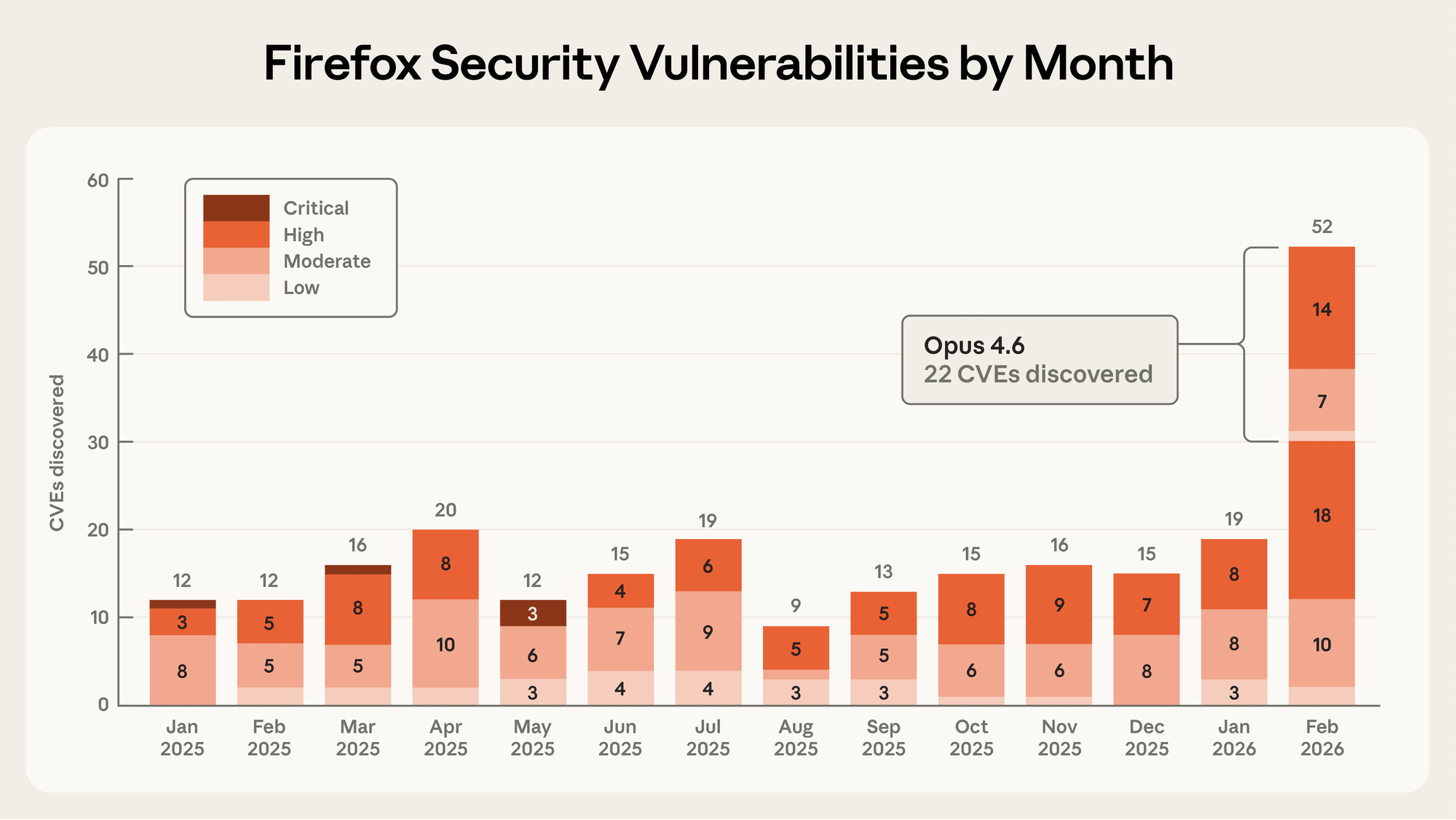
This partnership proves that AI agents are now capable of analyzing complex C++ and JavaScript codebases at a scale and speed impossible for human researchers alone. While the AI was highly effective at identifying flaws, the study noted it was less proficient at actually writing the exploits, suggesting a "defensive advantage" for AI in cybersecurity.
OpenAI is acquiring Promptfoo to bake AI security testing into Frontier
OpenAI announced it is acquiring Promptfoo, an AI security platform used by more than 25% of Fortune 500 companies, and plans to integrate its capabilities into OpenAI Frontier. The company says Promptfoo’s technology will strengthen built-in security testing, red teaming, evaluation, traceability, and governance, helping enterprises identify issues such as prompt injection, jailbreaks, data leaks, tool misuse, and out-of-policy behavior earlier in development.
This move signals that as AI moves toward autonomous "agents," security must be "baked in" rather than "bolted on." For enterprises, this means a safer environment for deploying agents that have access to sensitive corporate data and the ability to execute code.
Databricks acquires Quotient AI to improve agent evaluation in production
Databricks acquired Quotient AI to bolster continuous evaluation and reinforcement learning for AI agents across Genie, Genie Code, and Agent Bricks. Databricks says Quotient analyzes full agent traces from production systems to detect failures such as hallucinations, reasoning errors, and incorrect tool use, then uses those signals to support ongoing monitoring and performance improvement.
Databricks is acquiring Quotient AI to strengthen the agent evaluation and reinforcement learning capabilities in Genie, Genie Code, and Agent Bricks so customers get more reliable AI agents in production.
— Databricks (@databricks) March 11, 2026
Databricks already provides powerful tools for evaluating and improving… pic.twitter.com/XVuYPV65Rm
$100M for the Claude Partner Network
Anthropic has committed $100 million to a new Partner Network designed to accelerate enterprise AI adoption. The fund provides consulting firms and service providers with technical support, training, and joint go-to-market resources. The goal is to move enterprises from "AI curiosity" to "AI production" by building a robust support ecosystem.
Legora hits a $5.55B valuation as legal AI keeps accelerating
Legora, an AI platform for lawyers, reached a $5.55 billion valuation after raising a $550 million Series D to fund U.S. expansion. TechCrunch notes that the company is growing despite pressure from Harvey, Microsoft Copilot, and general-purpose LLMs, underscoring that vertical AI software can still command enormous investor confidence when it becomes deeply embedded in workflows.
The funding will fuel a massive expansion into the U.S., with new hubs planned for Chicago and Houston. Legora distinguishes itself by moving beyond simple document search into end-to-end "agentic" workflows. With Legora, AI doesn't just find a case but actually drafts the research and suggests strategy in a collaborative environment.
Harvey turns Workflow Builder into Agent Builder
Harvey has evolved Workflow Builder into Agent Builder, allowing teams to create and share reusable workflow agents tailored to specific teams, practice areas, or internal processes. Teams can embed templates that guide how work is produced, improving output quality and making the resulting agents easier to reuse for similar tasks in the future.
Introducing Agent Builder in Harvey. Teams can build autonomous agents, while still retaining control where it counts.
— Harvey (@harvey) March 9, 2026
Teams have already made 25K+ agentic workflows in Harvey. Now, these agents can plan, reason, and execute end-to-end. pic.twitter.com/2t4gMn3ZlI
Gemini in Sheets is getting closer to human-level spreadsheet work
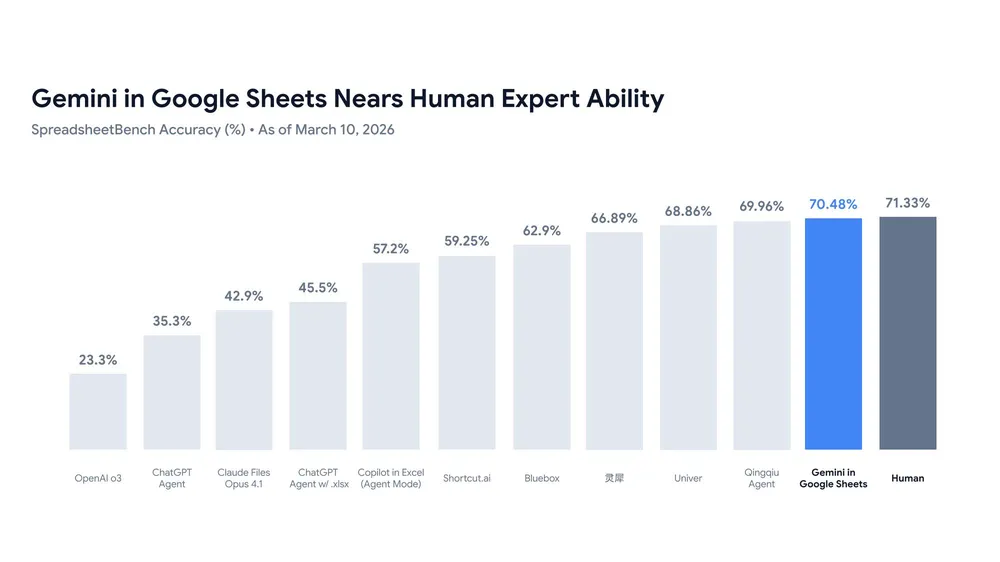
Google announced new beta capabilities for Gemini in Sheets that let users create, organize, and edit entire sheets simply by describing what they need. Google says the system can set up full spreadsheet workflows, generate categorized or summarized content with “Fill with Gemini,” and pull in real-time information from Search. On benchmark performance, Gemini in Sheets scored 70.48% on SpreadsheetBench, which Google says is state-of-the-art and approaching human expert ability.
Google is making Gemini more useful across Docs, Slides, Sheets, and Drive
Google’s latest Workspace updates extend Gemini’s role from helper to active collaborator. In Sheets, it can build spreadsheets from prompts and fill missing data. In Slides, users can ask Gemini to create a fully editable slide, collaboratively revise it, and eventually generate entire decks from a single prompt. In Drive, Gemini can now provide AI overviews, answer questions across files, and synthesize information from documents, emails, calendar, and the web with citations.
Glean now lets agents connect to remote MCP servers
Glean announced support for connecting remote MCP servers to its Assistant and Agents experience. This allows users to securely discover and invoke third-party tools from systems like Notion, Asana, GitHub, HubSpot, and more through a unified interface. Glean emphasizes admin-gated setup, centralized control, and human-in-the-loop experiences for write tools, showing how MCP is being operationalized as a controlled enterprise integration layer.
StackAI launches new features
StackAI introduced three new capabilities aimed at making agents more execution-oriented: computer use, browser use, and sub-agent coordination. The company frames this as a shift from narrow agents to “AI employees,” where systems can read repositories, run scripts, build decks, send emails, navigate interfaces without APIs, and break one objective into delegated tasks handled by specialized sub-agents.
 Tycologics
Databricks launches Genie Code as an autonomous partner for data work
Databricks introduced Genie Code, describing it as an autonomous AI partner for data workflows. It is available inside notebooks, the SQL editor, and Lakeflow Pipelines, and can handle multi-step planning and execution across notebooks, dashboards, and pipelines in a single thread. Databricks also says Genie Code can proactively monitor Lakeflow pipelines and AI models, investigate anomalies, support ML workflows end-to-end, and track experiments in MLflow.
Databricks Genie Space keeps pushing self-serve analytics via natural language
Databricks’ Genie space lets business users query organizational data with natural language, automatically translating prompts into SQL and returning results or visualizations. Companion Genie spaces for dashboards are now in public preview, allowing business teams to conduct self-serve analytics while staying within existing access controls managed through Unity Catalog. Benchmarking and feedback mechanisms are also built in to improve quality over time.
Great answers start with a well-curated Genie space 🧞
— Databricks (@databricks) March 4, 2026
A Genie space brings together governed data, defined metrics, and business context so teams can ask questions about their data in natural language and get answers grounded in your actual definitions and relationships.… pic.twitter.com/vcz5LPLe7r