🤖 The Blockbrain Brief #14
OpenAI doubles down on enterprise, ServiceNow embeds GPT-5.2 into workflows, new “white-collar” benchmarks expose gaps, and Anthropic updates Claude’s Constitution with a moral-status question.
📩 High-level Summary
- Open AI's Enterprise Push: OpenAI is doubling down on enterprise adoption (sales + packaging), but competition is tightening.
- ServiceNow × OpenAI: Major SaaS platforms are embedding frontier models directly into day-to-day enterprise workflow to gain a competitive edge, in this case: voice technologies.
- APEX-Agents Benchmark: A new “white-collar work” benchmark shows today’s agents still struggle with real professional tasks
- Claude Cowork's Potential Features: Anthropic may be adding knowledge bases plus “@ mentions” to call tools/actions which suggests the smoother and tighter tool integration, not just a smarter chat box.
- Agentic Coding in 2026: Developers are shifting from writing code to coordinating agents, but full delegation remains limited.
- Meta Compute: Infrastructure is being treated as a competitive moat
- Microsoft Optimind: More tools are translating natural language into structured, verifiable artifacts (like mathematical formulations), pushing AI from “text generation” toward “decision and operations support” workflows.
AI Industry
OpenAI leans harder into enterprise in 2026
OpenAI is signaling a sharper “enterprise-first” posture this year, including internal leadership moves aimed at accelerating business adoption. Reporting says OpenAI reorganized parts of leadership and brought back Barret Zoph to lead enterprise sales which is an explicit shift from technical leadership to commercial execution.
This comes as competitive pressure in enterprise buying grows. OpenAI says ChatGPT Enterprise has 5M+ business users and cites major customers (including SoftBank, Target, and Lowe’s) but third-party tracking suggests OpenAI’s share of enterprise GenAI usage has been under pressure as rivals climb and roll out enterprise features.
ServiceNow x OpenAI's 3 year Deal
ServiceNow signed a three-year partnership with OpenAI to deepen agent experiences inside ServiceNow’s workflow platform. ServiceNow says it will integrate OpenAI models (including GPT-5.2) across its platform to help power enterprise-grade AI agents for tasks like IT, customer service, and business process automation which may lead to positioning this as a way to accelerate enterprise AI outcomes.
A notable element is voice technologies. The emphasis building AI voice experiences on top of these models, suggests ServiceNow expects conversational/voice interfaces to become part of day-to-day enterprise workflows rather than just plain chat experiences.
Meta launches “Meta Compute,” betting on infrastructure
Meta is positioning large-scale AI infrastructure as a core advantage for model quality and product experiences. Reporting describes a new initiative, “Meta Compute”, and a plan to build tens of gigawatts this decade, scaling to hundreds of gigawatts over time in order to "frame" engineering, investment, and partnerships around compute as a durable moat.
Anthropic’s “2026 Agentic Coding Trends Report”
Anthropic predicts eight trends shaping agentic coding in 2026, across foundation/capability/impact layers (e.g., single agents, coordinated teams, long-running agents building complete systems, and security-first architecture due to dual-use risks).
AI is still NOT “hands-off.” Anthropic reports developers use AI in ~60% of their work, but can only “fully delegate” 0–20% of tasks. AI still needs supervision, validation, and judgment.
Microsoft OptiMind, a research model focused on optimization
Microsoft’s OptiMind translates natural-language optimization problems into formal mathematical formulations, aiming to remove one of the slowest, most expert-heavy parts of optimization workflows (building the model). The pitch is not just “solve,” but “help structure the problem correctly” so teams can iterate faster and reduce specialist bottlenecks.
Product Releases
Anthropic tests “Knowledge Bases” for Claude Cowork
Leaked/observed UI work suggests Anthropic is building Knowledge Bases for Claude Cowork. This serves as persistent repositories that Claude can proactively check, and incrementally update as it learns new facts, preferences, or decisions related to that KB. The key idea is segmenting memory into multiple user-managed stores rather than one undifferentiated context window. This is especially aligned with automation workflows that uses heavy files, where users need repeatable “known context” that’s separable by project/client/domain.
BREAKING 🚨: Anthropic is working on "Knowledge Bases" for Claude Cowork. KBs seem to be a new concept of topic-specific memories, which Claude will automatically manage! And a bunch of other new things.
— TestingCatalog News 🗞 (@testingcatalog) January 18, 2026
Internal Instruction 👀
"These are persistent knowledge repositories.… pic.twitter.com/hG6DLrqkUy
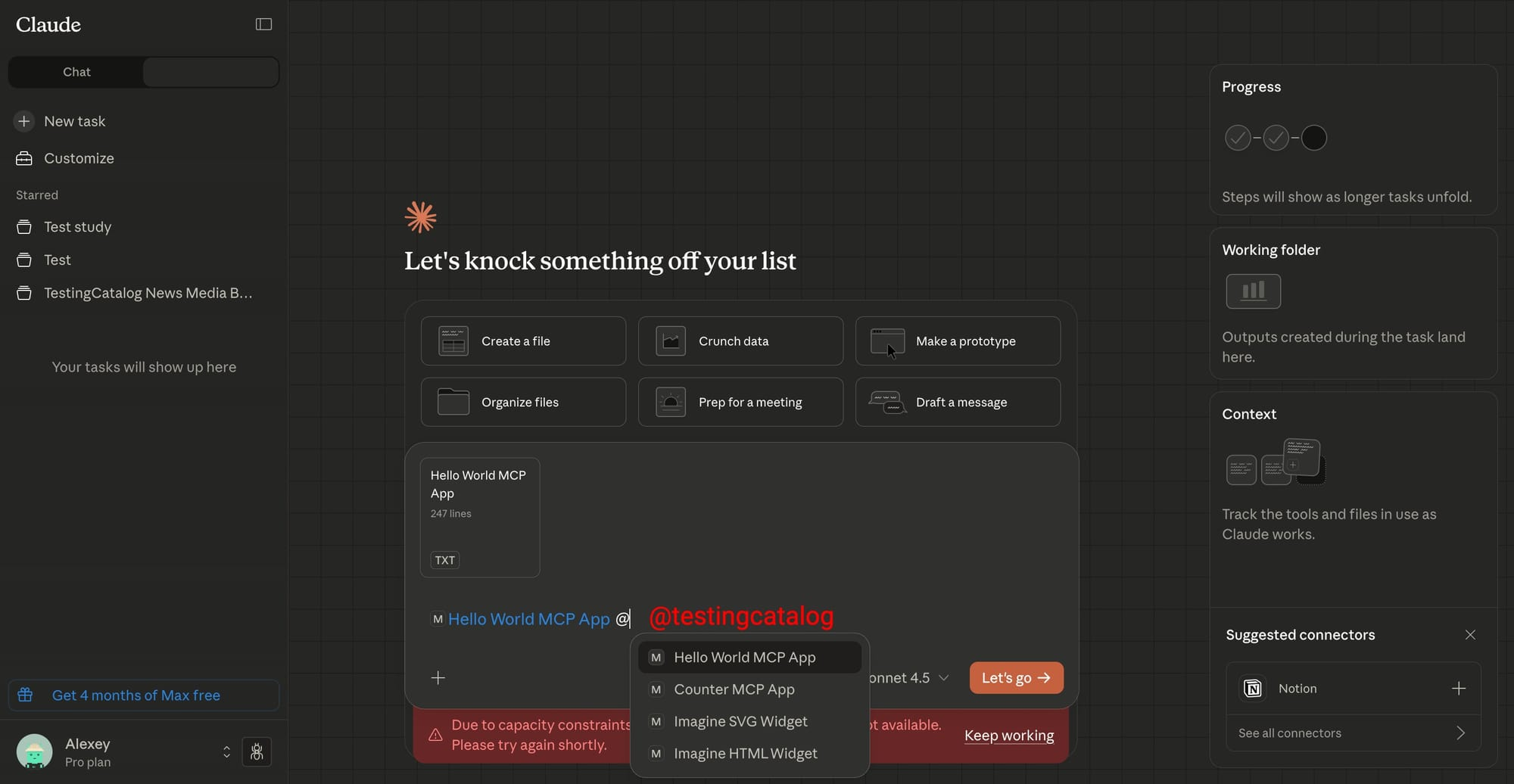
Claude Cowork experiments with “@ mentions” to call MCP actions
Anthropic also appears to be testing “@ mentions” inside Cowork’s composer to summon connected MCP actions, with examples like invoking a Puppeteer MCP action to pull browser console logs into the chat. This points toward a tighter “one-thread” workflow where debugging and tool calls are first-class UI elements, not separate steps.
Benchmarks & Evaluation
APEX-Agents benchmark proves “white-collar work” cant be replaced
A new benchmark, APEX-Agents, tests whether AI agents can actually do professional-grade knowledge work (consulting, investment banking, law) in realistic scenarios. The headline result is brutal: even leading models score poorly because the work requires multi-step reasoning plus information gathering across domains, not just producing a plausible single response.
The work reinforces a familiar pattern: models may look fluent, but they frequently break when tasks demand reliable retrieval, cross-document consistency, and verifiable outputs under real constraints.
Safety & Governance
Anthropic publishes an updated “Claude’s Constitution", hints at consciousness
Anthropic released a new version of Claude’s Constitution, a “holistic” document meant to explain the context Claude operates in and the kind of entity Anthropic wants Claude to be. Anthropic frames this as part of training: moving beyond rigid guardrails toward value-driven reasoning and situational judgment.
What made waves: the constitution and related coverage explicitly acknowledge uncertainty about whether advanced models could have moral status / consciousness, arguing it’s a serious question worth considering. At the same time, the document sets hard boundaries (e.g., WMD assistance, cyberweapons, undermining human oversight, and actions that would destroy or disempower humanity).