🤖 The Blockbrain Brief #10
Governed tools, browser-native automation, better memory compression, and safer long-running agents while legal shifts reshape how AI ships.
📩 High-level Summary
- Enterprise Agent Ops: Google is turning agents into admin-friendly software with tool registries, governance controls, and production memory (sessions + memory bank) that make deployment repeatable across teams.
- Browser Agents: Claude’s Chrome rollout signals that “agents inside the browser” is becoming default to be able to navigate real sites, execute workflows, and ship with enterprise controls (allowlists/blocklists, org settings).
- Memory + Compression: The differentiator is shifting from “more context” to better continuity is structured summaries that preserve an artifact trail (what changed, decisions, next steps) outperform generic compression for long-running work.
- Safety via Observability: OpenAI’s monitorability work suggests reasoning traces predict behavior better than actions/outputs, pushing agents toward trace + monitor patterns in production.
- Compliance + Data Provenance: Google’s SerpApi action highlights rising legal risk; licensed access, provenance flags, and policy-aligned retrieval are becoming procurement requirements, not nice-to-haves.
Newly Advanced governance for Vertex AI Agent Builder
Google is pushing Vertex AI Agent Builder toward “enterprise-grade agent operations,” with a big emphasis on tool governance + reusable tooling + production memory. A key move is integrating Cloud API Registry directly into the Agent Builder console so admins can curate which tools developers can use across the org, instead of each team rebuilding tools from scratch. Developers then access those governed tools via a new ApiRegistry interface.
Claude in Chrome expands to all paid plans
Anthropic’s Claude-in-Chrome rollout is turning into a full “browser agent” stack. As of Dec 18, 2025, it’s available (beta) to all paid plan subscribers (Pro, Team, Enterprise). The release notes highlight: Claude Code integration (debug in terminal, verify in browser with access to DOM/network/console), the ability to control browser actions from Claude Desktop, and “record a workflow” so Claude can repeat multi-step browser tasks. Team/Enterprise also get admin controls like org-wide enable/disable plus allowlists/blocklists for site access.
Earlier updates show a steady march toward autonomy: scheduled recurring tasks, “approve the plan then execute,” model selection (Haiku/Sonnet/Opus), multi-tab work, and deeper understanding of common sites (Slack, Google Calendar, Gmail, Docs, GitHub).

Release Notes Updates
Google vs SerpApi for “unlawful scraping”
Google announced it has filed suit against SerpApi alleging the company circumvents security measures protecting copyrighted content appearing in Search results, overrides websites’ crawling directives, and uses tactics like cloaking and large bot networks with fake/rotating crawler names. Google also claims SerpApi takes content Google licenses (e.g., certain Knowledge Panel/real-time data components) and resells it for a fee. The post frames this as a last resort after significant anti-abuse efforts and notes the activity has increased “dramatically” over the past year.
Which Agent Compacts Conversation Best?
Factory.ai published a very practical evaluation of “memory compression” for long-running agents (debugging, PR review, feature work). Their headline: structured summarization retained more useful info than alternatives from OpenAI and Anthropic in their tests. The key idea is measuring “can the agent continue the task?” not ROUGE or embedding similarity. They built probe-based evals (Recall, Artifact/file tracking, Continuation/next steps, Decision reasoning) and graded answers with an LLM judge (GPT-5.2) across dimensions like accuracy, context awareness, artifact trail, continuity, and instruction-following.
They compare three approaches:
- Factory: “anchored iterative summarization” with explicit sections (intent, file mods, decisions, next steps) and incremental updates
- OpenAI:
/responses/compactopaque compressed representations (very high compression, less interpretable) - Anthropic: structured summaries regenerated on each compression cycle
Factory reports small compression-ratio differences (all ~98–99% reduction), but meaningful quality gaps; they argue the real target is “tokens per task,” not “tokens per request."
OpenAI's New Chain-of-thought Benchmark
OpenAI introduced a framework to evaluate how well a monitor can infer properties of an agent’s behavior by observing signals like chain-of-thought (CoT) versus actions/outputs alone. The post introduces a suite of 13 evaluations across 24 environments, grouped into intervention, process, and outcome-property archetypes, to measure monitorability systematically.
The central result: monitoring chain-of-thought is substantially more effective than monitoring actions/outputs alone in almost every setting studied; models that “think” longer tend to be more monitorable, and reinforcement-learning optimization at current frontier scales does not appear to meaningfully degrade monitorability. They also discuss tradeoffs (a “monitorability tax”: more inference compute can yield easier monitoring at comparable capability) and note follow-up questioning can improve monitorability further.
ChatGPT: New “Characteristics” controls (warmth, enthusiasm, emoji use, formatting)
OpenAI’s Help Center describes “Characteristics” as knobs to fine-tune response vibe (tone, brevity, formatting, emoji level, etc.) across chats, working alongside personality presets, custom instructions, and memories. Users adjust sliders in Personalization, nudging each characteristic “more” or “less” (examples include Warmth, Enthusiasm, Headers & Lists, Emojis). The article also notes rollout is gradual.
You can now adjust specific characteristics in ChatGPT, like warmth, enthusiasm, and emoji use.
— OpenAI (@OpenAI) December 19, 2025
Now available in your "Personalization" settings. pic.twitter.com/7WSkOQVTKU
Anthropic: Skills + MCP servers
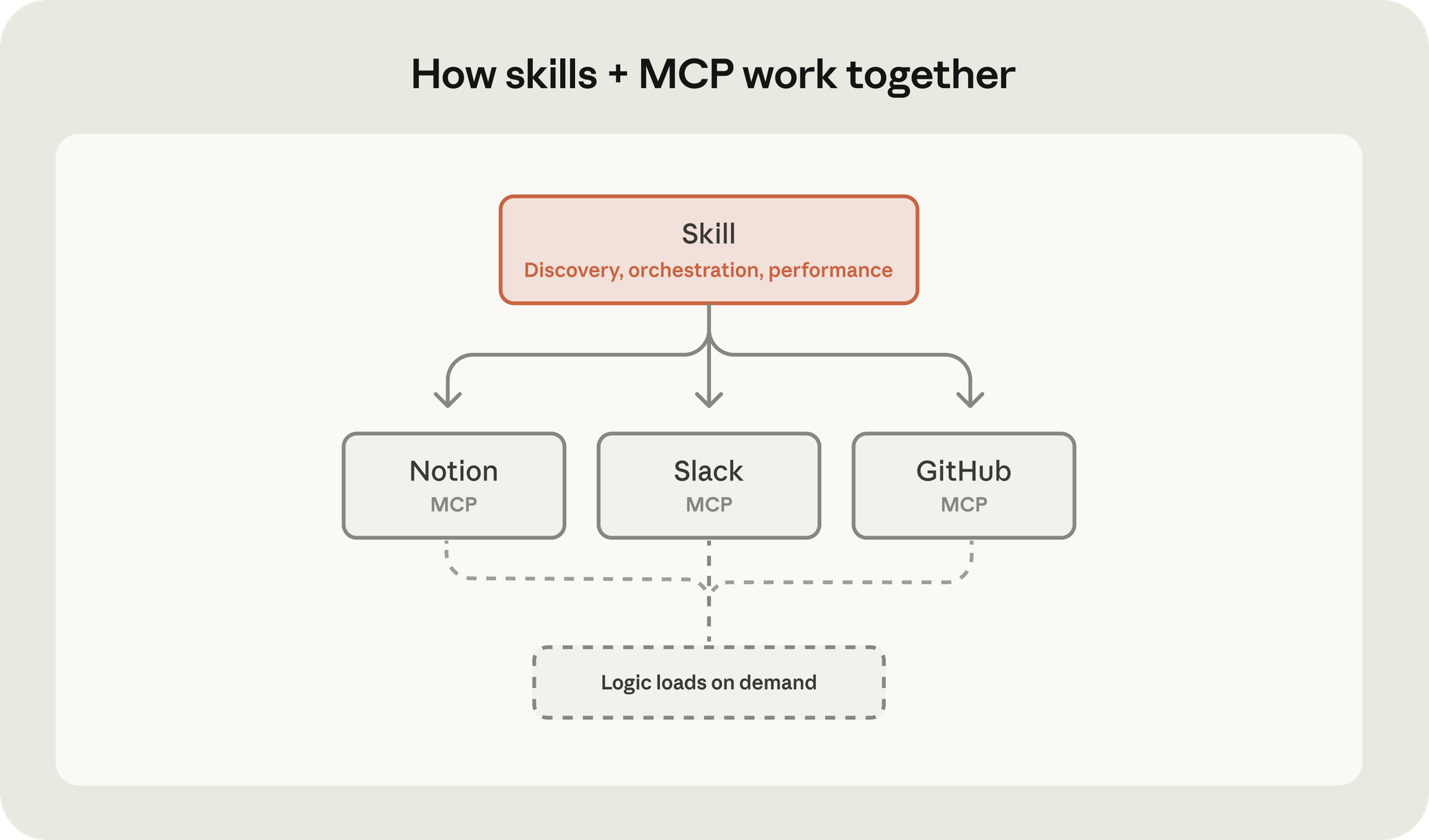
Anthropic clarifies a clean separation: MCP (Model Context Protocol) servers handle connectivity (secure, standardized access to tools/data like GitHub, Salesforce, Notion, internal APIs), while skills handle expertise/workflow logic, the procedural knowledge that makes tool access produce consistent outcomes (what to query, in what order, how to format results, what edge cases matter). They emphasize composability: one skill can orchestrate multiple MCP servers; one MCP server can support many skills; add a new connection and existing skills can use it.