🤖 The Blockbrain Brief #1

Recommended Next Steps
- Integrate Claude 4.5 Haiku into the platform
- Look into Salesforce and Slack integration templates
- Rationale: To replicate similar embedded Blockbrain use cases
- Track Veo 3.1’s rollout closely
- Rationale: Evaluate early access for Blockbrain’s marketing and research storytelling
- Research Team will continue monitoring Gemini 2.5 “Computer Use” for future agentic UI automation. We will take note of benchmarks, privacy compliance, and API availability.
- Research Team will observe VaultGemma’s DP scaling methods as possible future inspiration for privacy-grade fine-tuning or embeddings in regulated deployments.
High-Level Summary
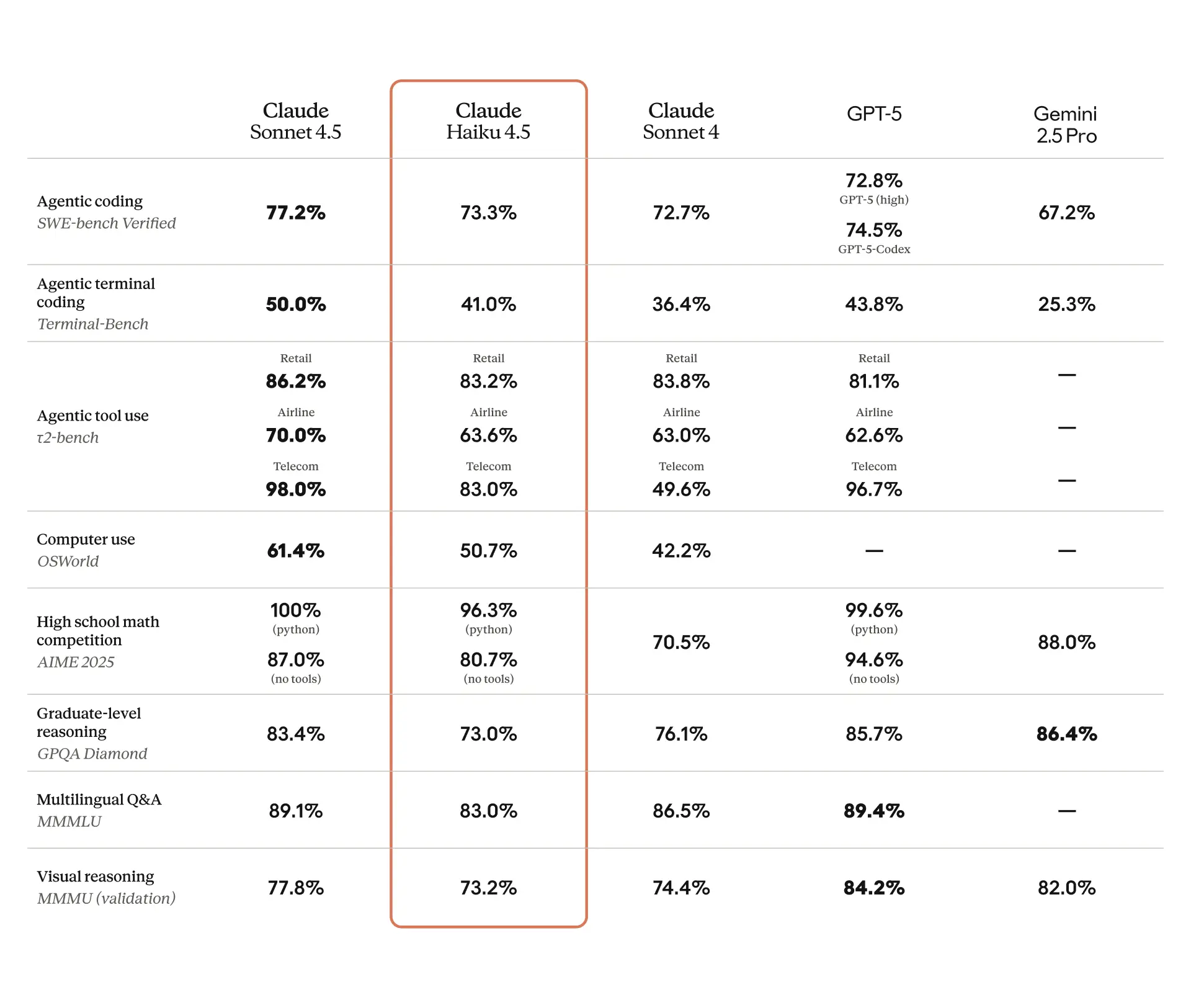
- LLMs: Anthropic released Claude Haiku 4.5, a faster and cheaper model, alongside Sonnet 4.5, which delivers stronger coding performance.
- Enterprise Integrations: Anthropic expanded its partnership with Salesforce, embedding Claude into Agentforce and Slack.
- Agentic Systems: Gemini 2.5 “Computer Use” introduced direct UI-interaction capabilities, allowing applications and browser control.
- Video Generation: Veo 3.1 and Flow updates added richer generated audio and improved image-to-video fidelity.
- Data Privacy: Google launched VaultGemma, a differentially private LLM designed for regulated sectors.
LLM Breakdown
Claude Haiku 4.5 (link)
- A new “small” model positioned as near-frontier for coding: ~Sonnet 4 levels on some tasks, ~⅓ the cost, >2× speed; priced at $1/$5 per million (in/out). Also emphasizes safer alignment profile (ASL-2). Why it matters: materially lowers unit economics for agentic/coding assistants and high-throughput chat.
Released Oct 16, 2025.
Enterprise Integrations
Anthropic’s partnership with Salesforce (link)
- Salesforce and Anthropic have expanded their collaboration to embed Claude across the Salesforce ecosystem. Claude is now a preferred model within Agentforce (Salesforce’s AI automation layer via Bedrock), powering intelligent customer and workflow agents.
- Salesforce is also deploying Claude Code internally to assist its own developers, while Slack integrations enable direct access to Claude for day-to-day collaboration.
- For Anthropic, it seems to be a major step in turning Claude from a standalone model into an embedded, workflow-level enterprise assistant reaching thousands of regulated organizations.
Agentic Systems
Gemini 2.5 “Computer Use” (link)
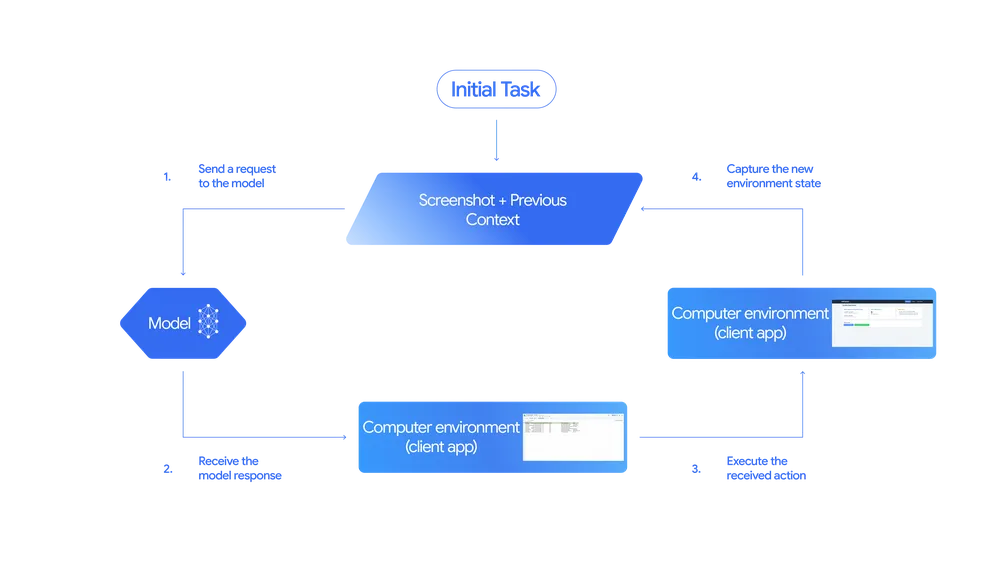
- Overview: A new Gemini 2.5 variant that allows agents to interact directly with UIs. This can execute real browser or app actions such as clicks, scrolls, form fills, and navigation.
- Mechanics: The model receives a user task, screenshot, and action history, then outputs a function call (e.g.,
click(x, y)ortype(text)), which is executed by a client before looping back with new context. - Performance: Google reports that it outperforms leading alternatives on web and mobile control benchmarks with higher accuracy and lower latency.
- Safety: Each action is filtered through a safety layer and optional developer restrictions. Sensitive actions can require user confirmation.
- Scope: Currently optimized for browser and app automation; not designed for deep OS-level control.
- Why it matters: This bridges reasoning and execution, allowing LLMs to act directly within digital interfaces. It enables practical agentic workflows without relying on traditional RPA systems.
Video Generation
Veo 3.1 + Flow Upgrades (link)
- Overview: Google introduced Veo 3.1 alongside major Flow enhancements on October 15, 2025. The update focuses on richer audio generation, longer video support, and improved scene realism.
- Audio capabilities: Flow now integrates audio across more modules, including Ingredients to Video, Frames to Video, and Extend. Users can generate synchronized ambient sound, dialogue, and music directly with the video output.
- Visual quality: Scene realism has improved through better lighting, shadow accuracy, and motion smoothness. Veo 3.1 achieves more natural frame transitions and object stability in multi-scene clips.
- Extended generation: The Extend feature supports up to one minute of coherent footage, compared to the 8-10 second limit in earlier versions. Multi-prompt chaining and consistent scene continuation are now available.
- Editing and composition: Flow introduces tools for object removal, color grading, and scene refinement. These allow users to adjust specific elements without regenerating entire clips.
- Formats and resolution: Veo 3.1 supports vertical (9:16) video, 1080p resolution, and improved rendering for social and mobile formats.
- Access and API: The model is available through the Gemini API and the Flow web interface for Pro and Ultra users, with additional integrations planned for platforms like Canva and YouTube Shorts.
- Why it matters: Veo 3.1 moves video generation closer to production quality. The addition of audio, improved realism, and vertical format support allow creative and marketing teams to generate complete, ready-to-publish video assets directly within Google’s ecosystem.
Data Privacy
VaultGemma: The world's most capable differentially private LLM (link)
- Overview: Google released VaultGemma, a 1B-parameter variant of Gemma 2 trained with differential privacy (DP-SGD) to prevent memorization of sensitive data.
- Technical significance: Introduces new DP scaling laws outlining how compute, noise, and batch size affect the privacy–utility tradeoff in LLMs.
- Performance: Despite added noise, VaultGemma maintains strong benchmark results, approaching older open-weight LLM performance while preserving privacy guarantees.
- Why it matters: Showcases interest towards privacy-first foundation models, enabling safer deployment in healthcare, finance, and other regulated sectors.